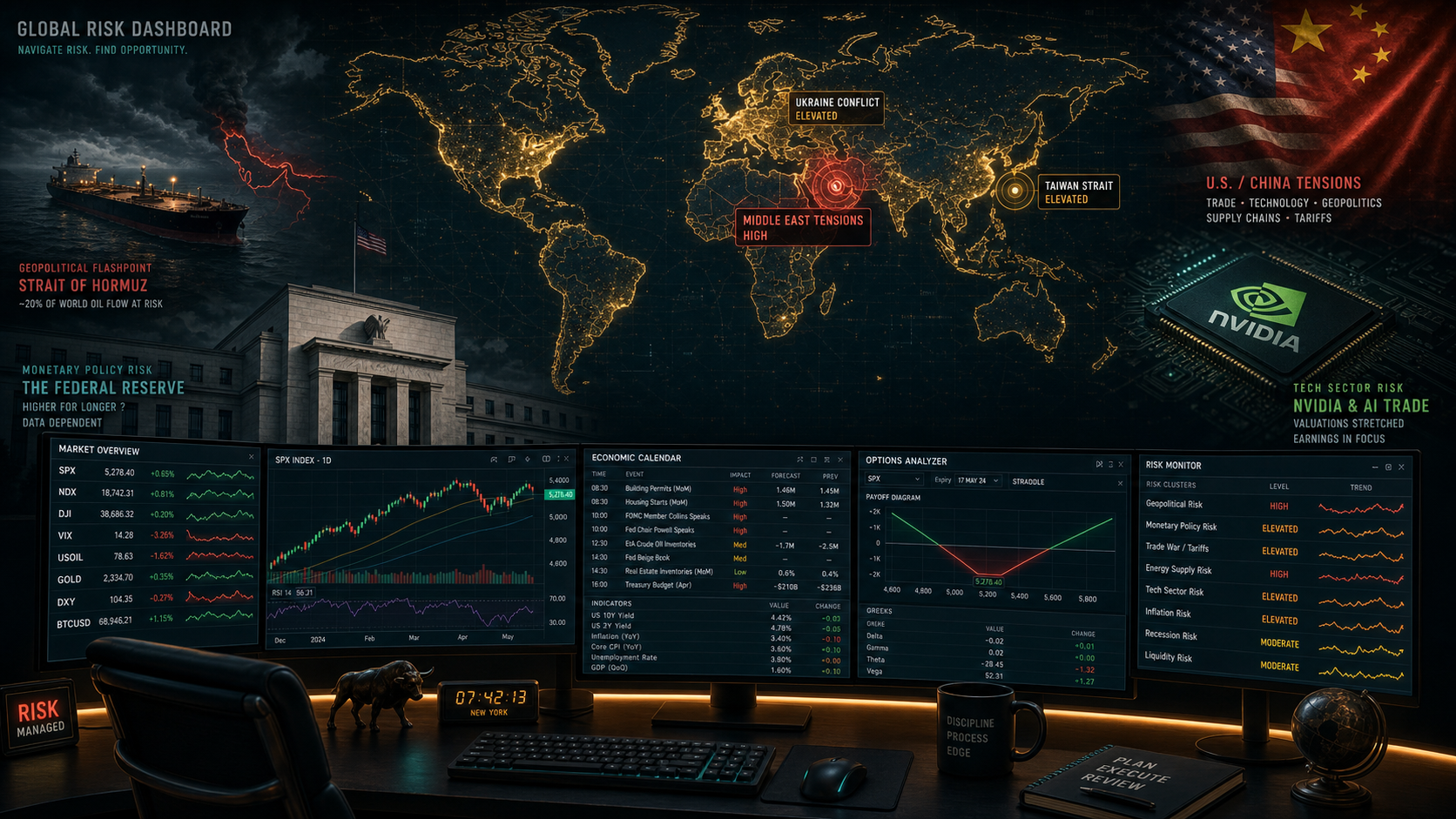
Weekly Market Risk Outlook: May 15–22, 2026
This is one of the most catalyst‑laden weeks of 2026. Four macro‑level risk clusters converge at once: a fragile Iran war ceasefire that could collapse or break through at any moment; the afterglow of the Trump–Xi Beijing summit with unresolved structural tensions; the debut of newly confirmed Fed Chair Kevin Warsh and the April FOMC minutes (with a rare 8–4 dissent); and a front‑loaded earnings week headlined by NVIDIA, Walmart, Home Depot, Target, and Lowe’s. With April CPI at 3.8% and oil still well above $100/bbl due to Strait of Hormuz disruption, markets are pricing an awkward mix of earnings growth optimism and stagflation risk. Volatility risk is asymmetric to the upside.
Macro Risk Cluster #1: Iran War & Strait of Hormuz
This remains the single largest tail risk hanging over global markets, and this week could force a resolution — or a return to full hostilities.
As of May 14, the fragile ceasefire established on April 7 is technically in place but deeply strained. Iran has explicitly rejected the U.S. 14‑point memorandum proposal, calling it an attempt to “impose surrender.” Iran’s parliament set five conditions before re‑entering negotiations: ending all fronts of the war (including Lebanon), lifting the U.S. naval blockade, releasing frozen Iranian assets, receiving war reparations, and — most controversially — U.S. recognition of Iranian sovereignty over the Strait of Hormuz. Washington has firmly rejected the last condition as a violation of freedom of navigation.
The Strait of Hormuz remains effectively closed to normal commerce. Before the conflict, the waterway handled ~129 daily transits; by early May, that figure had fallen to roughly 20 vessels. Estimates suggest the closure has removed ~14.5 million barrels per day from global supply — an unprecedented disruption. Brent has traded above $100/bbl for weeks, with prediction markets assigning nearly 50% odds of WTI hitting $110 in May. Saudi Aramco has warned jet fuel and petrol stocks could reach critically low levels if the strait stays closed.
- Breakthrough (positive shock): A credible announcement of a new memorandum or ceasefire extension would likely trigger a sharp oil collapse (Brent down 10–15% in a session, similar to the May 5–6 “closing in on deal” plunge to ~$98) and an equity surge, especially in energy‑sensitive sectors.
- Escalation (negative shock): U.S. officials insist on safeguards ensuring Iran never acquires a nuclear weapon. Iranian politicians have floated enriching uranium to weapons‑grade levels if conflict resumes. Any renewed strikes or collapse of talks could send oil above $120, spike the VIX, and broadly pressure equities.
- Status quo (limbo): The base case is continued headline‑sensitive trade: elevated vol in energy and geopolitical risk assets with sharp intraday reactions to social media posts or state media leaks.
Trader takeaway: headline risk from Iran is live every session. Intraday posts from U.S. leadership or Iranian media can move oil 2–5% in minutes, and options should continue to price elevated implied volatility in energy‑linked names and macro ETFs.
Macro Risk Cluster #2: Trump–Xi Summit Aftermath & China Data
The Beijing summit delivered “stabilization, not breakthrough,” leaving several structural fault lines unresolved just as key China data and PBOC decisions hit.
Trump and Xi held their first in‑person summit since late 2025, with a delegation including Elon Musk, Jensen Huang (NVIDIA), and other U.S. business leaders. The tone was framed as stabilization rather than solution. Key outcomes:
- Agreement to pursue a three‑year “strategic stability” framework.
- Expectation that the October 2025 trade truce (tariffs and mineral export restrictions) will be extended.
- China signaled willingness to buy additional U.S. soybeans, beef, and Boeing aircraft.
- Two new bilateral mechanisms announced to manage trade in “non‑sensitive goods” and investment issues.
Key unresolved issues: state subsidies, Indo‑Pacific posture, Taiwan, China’s nuclear build‑out, and U.S. chip export controls. Chinese media struck a cooler tone than Trump’s public optimism, hinting that no formal deal is finalized.
Jensen Huang’s presence in Beijing has been read as a signal that export‑license news on NVIDIA chips sold to China could be in play. NVIDIA’s H20 chips (a China‑specific downgrade) were restricted again in early 2025. Any relaxation of AI chip export rules — even partial — would be a material upside catalyst into NVDA’s May 20 earnings.
On Monday May 18 at 2:00 AM ET, China releases April industrial production and retail sales. Misses, especially in retail, would pressure commodities and global growth sentiment into an already fraught week. The PBOC meets Wednesday, May 20 at 1:15 AM ET; rates are expected to stay at 3.00%, but any easing signal would be a global risk‑on catalyst.
Macro Risk Cluster #3: Fed Leadership Transition & FOMC Minutes
A new Fed chair, an 8–4 dissent, and oil‑driven inflation acceleration collide in one of the most consequential central‑bank weeks in years.
Kevin Warsh was confirmed as Fed chair on May 13 in a 54–45 vote — the most partisan confirmation in modern Fed history. Powell’s term ends May 15, and Warsh is expected to chair the June 16–17 FOMC meeting. The transition comes as inflation re‑accelerates (April CPI 3.8%) and markets price roughly a 30% chance of a rate hike before year‑end. Warsh’s path to confirmation was delayed by a Justice Department probe into the Fed that was later dropped; investors will parse his first public remarks for any hawkish bias.
The April 28–29 meeting left rates at 3.50%–3.75%, but the vote split 8–4 — the largest dissent since 1992. Three regional presidents opposed language viewed as too dovish, while Governor Stephen Miran voted for a cut. The minutes will clarify how the Committee weighed the oil shock versus underlying core stickiness, the degree of hawkish concern among dissenters, any references to the Iran war’s economic impact, and the tone heading into Warsh’s first meeting. Given the vote and the subsequent 3.8% CPI print, the minutes are likely to read hawkish‑to‑neutral at best.
| Minutes tone | Likely reaction |
|---|---|
| Hawkish (hint at hikes, broad inflation concern) | Rates spike, USD up, equities sell off — especially tech/growth. |
| Neutral / uncertain (wait‑and‑see on Iran) | Muted; existing risk‑off lean persists, with choppy trading. |
| Dovish surprise (inflation seen as temporary) | Cut odds reprice, equities rally, USD softens, duration outperforms. |
Fed speakers add color: Governor Waller speaks twice from Frankfurt (Mon and Fri), while Vice Chair Barr appears mid‑week. Together, they create a high signal‑density backdrop for rate expectations.
Economic Data Calendar: May 15–22
Housing, labor, and PMIs layer onto the Fed and geopolitical story, shaping how “stagflation vs. soft‑landing” gets priced.
| Day | Key event | Risk level |
|---|---|---|
| Fri 5/15 | Powell’s last day as Fed Chair; Iran ceasefire status | Elevated geo |
| Mon 5/18 | China IP & retail sales (2:00 AM ET); Baidu earnings (BMO); Waller policy panel | Moderate |
| Tue 5/19 | US housing starts & permits (8:30 AM); Home Depot earnings (BMO); Waller Frankfurt panel | Moderate |
| Wed 5/20 | PBOC rate decision (1:15 AM); UK CPI; FOMC minutes (2 PM ET); NVDA & INTU earnings (AMC); Target & Lowe’s (BMO); Barr speech | Highest‑risk day |
| Thu 5/21 | Initial jobless claims (8:30 AM); flash PMIs (9:45 AM); Walmart & Deere (BMO); TTWO earnings (AMC) | High |
| Fri 5/22 | Waller “Economic Outlook” lecture (10 AM ET); state employment & unemployment (10 AM) | Moderate |
Earnings Watch: NVIDIA & the Main Street Giants
A blockbuster lineup spans AI infrastructure, big‑box retail, home improvement, and gaming — all inside a single, crowded week.
NVDA reports Q1 FY2027 after the bell. Consensus calls for ~$1.76–1.77 in EPS on ~$78.6–78.9B in revenue, with Citi modeling ~$80B on stronger‑than‑expected Blackwell demand. The narrative is all about Blackwell GPU shipments and the Vera Rubin platform roadmap. China remains a wildcard: any hint of restored H20 or broader chip access would be an upside catalyst. Implied volatility is elevated, the stock is up sharply year‑to‑date, and “buy the rumor, sell the news” risk is very real.
Walmart reports Q1 FY2027 at 6:00 AM CDT. Consensus EPS is around $0.61, with analysts watching U.S. comp growth (~4%), trade‑down from higher‑income consumers, and e‑commerce momentum. Tailwinds include grocery share gains and FX; headwinds include diesel/freight costs, pharmacy pricing pressure, and cautious guidance given gas price uncertainty. The Street sits around a high‑$130s price‑target band with a broad Buy consensus.
Home Depot reports Tuesday pre‑market, with modest EPS pressure but revenue growth as Pro demand stabilizes. Target and Lowe’s follow Wednesday morning, offering a clean comparison of discretionary vs. staples‑heavy retail and Pro vs. DIY housing exposure. Deere, Intuit, Take‑Two, and Baidu add reads on construction, software & tax, gaming (GTA VI timing), and China tech sentiment.
This is the non‑scheduled risk that can override every other event on the calendar. The ceasefire has held since April 7 but has been punctuated by repeated exchanges of fire both sides describe as “below the threshold” for full‑scale war. On May 13, VP Vance said the U.S. was “making progress” but that the bar for a deal remained high. Iran’s new supreme leader Mojtaba Khamenei has vowed to manage the Strait under “new legal frameworks” and to maintain nuclear capabilities.
- Brent crude could spike to $120–130 in hours.
- VIX could jump 5–10 points intraday.
- S&P 500 futures might gap lower 2–4%.
- Airlines, shippers, and energy‑intensive sectors would be hit hardest.
- Energy producers and defense stocks would likely rally sharply.
Conversely, even a preliminary MOU could unleash a powerful “relief rally”: lower oil, tighter credit spreads, and upside in cyclicals, airlines, consumer discretionary, and any area currently weighed down by $4.50/gallon gas.
Cross‑Asset Risk Scorecard
A quick glance at how the main catalysts skew risk across assets this week.
| Risk factor | Direction bias | Magnitude | Timing |
|---|---|---|---|
| Iran deal progress / collapse | Binary (up/down) | Very high | Any session |
| FOMC minutes (hawkish) | Negative for equities/bonds | High | Wed 2 PM ET |
| NVDA earnings beat/miss | Positive for Nasdaq if clean beat | High (single stock, index read‑through) | Wed after close |
| Walmart earnings | Barometer for US consumer | Medium | Thu before open |
| China IP & retail sales | Positive if beat | Medium | Mon 2 AM ET |
| PBOC rate decision | Risk‑on if easing signal | Medium | Wed 1:15 AM ET |
| US housing starts (miss) | Negative for housing complex | Medium | Tue 8:30 AM ET |
| Flash PMIs (miss) | Negative for growth expectations | Medium | Thu 9:45 AM ET |
| Waller speeches (hawkish) | USD & rates up, equities down | Medium | Mon & Fri |
| TTWO GTA VI guidance | Binary, event‑driven | High (single stock) | Thu after close |
Volatility Positioning Considerations
For options traders, this week is structurally set up for elevated realized volatility with several overlapping macro and single‑stock catalysts.
- NVDA May 20 straddle/strangle: Implied volatility into earnings is likely elevated. Blackwell demand, China chip relief, and guidance on supply constraints are key drivers. Watch early reaction to any Trump–Xi chip headlines Monday/Tuesday as a leading signal.
- FOMC minutes IV crush on rates: TLT and rate‑sensitive ETFs (XLU, XLRE, IWM) could see outsized moves around 2 PM Wednesday given the 8–4 dissent backdrop and a new chair regime.
- Oil‑linked hedges: With WTI/Brent headline sensitivity extreme, broad equity exposure may warrant close monitoring of energy as a real‑time ceasefire proxy. A sharp Brent break below $95 would signal deal progress; a spike above $115 would hint at breakdown.
- New Fed chair risk premium: Markets are effectively pricing an unknown. Warsh has not yet chaired a meeting, and his first comments as incoming chair could move the entire rate complex. Waller’s speeches Monday and Friday are an important preview of the internal tone under new leadership.
This Weekly Market Risk Outlook is for educational and informational purposes only and is not financial, investment, tax, or trading advice. None of the scenarios or examples above constitute a recommendation to buy or sell any security, option, or strategy. Markets are risky and unpredictable, and the actual path of events may differ materially from any scenario described here. You should do your own research and consider consulting a qualified financial professional before making any investment decisions.
Trade Setup of the Week
Educational example only — a defined-risk volatility idea built around the week’s highest-impact catalysts.
Instead of gambling on the exact outcome of FOMC minutes or NVDA earnings, one tactical approach is to wait for the event, let the first market reaction happen, and then look for a defined-risk SPY call spread or put spread depending on whether the market’s first move looks like continuation or overreaction.
This week stacks several volatility catalysts on top of each other: the PBOC decision, FOMC minutes, NVDA earnings, Walmart earnings, flash PMIs, and the ever-present Iran/oil wildcard. That combination increases the odds of sharp index movement, especially if rates, oil, and mega-cap tech all start pulling in the same direction.
A debit spread keeps the maximum loss capped at the premium paid, which matters in a week where gap risk is real. If the market responds cleanly to the catalyst and follow-through develops, the spread can offer directional exposure without the unlimited decay and sizing issues of naked long premium.
- Event: Wednesday FOMC minutes at 2:00 PM ET, followed by NVDA earnings after the close.
- Instrument: SPY or QQQ weekly options.
- Bullish version: If minutes are less hawkish than feared and NVDA guidance confirms strong Blackwell demand, a short-dated call debit spread could express upside continuation.
- Bearish version: If minutes read hawkish, yields jump, and/or NVDA guidance disappoints, a short-dated put debit spread could express downside follow-through.
- Risk management idea: Let the first move happen first. If the initial reaction is chaotic, waiting for the first 30–60 minutes after the event can reduce the odds of chasing the worst entry.
Why not a pre-event straddle? Because implied volatility is already elevated into the event cluster, and the outlook itself points to likely IV richness around NVDA and rates-sensitive assets. Waiting for the reaction can sometimes create a cleaner directional trade than paying peak premium into the unknown.
The setup becomes less attractive if the minutes land as a non-event, NVDA reaction is mixed, or geopolitical headlines reverse the market unexpectedly. This is a week where cross-currents can overpower any single thesis very quickly.
The broader lesson is not “predict the market perfectly,” but rather to identify where risk is clustered, wait for information to be revealed, and use a structure with predefined downside. In a catalyst-heavy tape, surviving the wrong thesis matters as much as monetizing the right one.
This trade setup is provided for educational and informational purposes only and is not financial advice. It is not a recommendation to buy or sell any security, option, or strategy. Options involve substantial risk, can lose value quickly, and may not be suitable for all investors. Always do your own research and consider consulting a licensed financial professional before trading.